
Irregular Heartbeat
A clear, reassuring guide to what an irregular heartbeat can feel like, what it may mean, and when it should be checked.
Written by Ian Murray, Cardiac Physiologist
Most of the time, your heartbeat goes about its work quietly and steadily, without asking for your attention.
But when that rhythm feels uneven — perhaps a flutter, a pause, a thump, or a beat that seems out of step — it can be unsettling and confusing.
Sometimes an irregular heartbeat is brief. Sometimes it is the kind of change that needs proper attention. The difficult part is that you usually cannot tell the difference from sensation alone.
That is what makes this topic worth understanding. Like high blood pressure, changes in heart rhythm can sometimes become another silent issue — easy to miss, easy to misunderstand, and worth noticing early.
This page explains what people mean by an irregular heartbeat, how it differs from a normal rhythm, what a home blood pressure monitor may be picking up, and when it is sensible to seek medical advice.
Quick overview
Use the links below to jump to the section you need:
What is a normal heart rhythm?
Most of the time, your heart follows a steady electrical pattern that tells the heart muscle when to squeeze and when to relax.
A useful way to picture this is as a well-made clock. Each part moves in the right order, at the right moment, so the timing stays smooth. Your heart works in a similar way.
A small natural electrical signal starts each beat, travels through the heart along a set path, and helps the upper and lower chambers work together.
This is what creates a normal heart rhythm: not simply a heartbeat that is fast or slow, but one that is organised.
On our page How the heart works, we explain how this timing begins in the heart’s natural pacemaker and spreads through the heart muscle.
Video showing how each heartbeat begins with a small electrical signal high in the heart. The signal spreads across the upper chambers, pauses very briefly, and then travels through the lower chambers to create a steady, organised rhythm.
A normal rhythm is not perfectly mechanical. It can speed up when you walk, climb stairs, or feel stressed. It can slow down when you are resting or asleep. What matters is that, even when the speed changes, the rhythm is still controlled in an organised way.
That matters here because when people talk about an irregular heartbeat, they are usually describing a change in that usual pattern.
What does an irregular heartbeat mean?
An irregular heartbeat means the heart is no longer keeping its usual steady pattern. Instead of feeling even and predictable, it may seem to skip, flutter, pause, thump, or beat in a way that feels out of step.
Using the clock idea, it is a little like a clock that normally ticks evenly, then suddenly goes tick-tick ... tick ... tick-tick for a short time. It is still working, but the timing no longer feels smooth.
This is where it helps to separate rhythm from speed. A heartbeat can be fast and regular, such as during exercise. It can be slow and regular, such as when you are resting. An irregular heartbeat is different. The main issue is not just how fast the heart is beating, but whether the beats are arriving in a steady order.
Regular and irregular rhythm: a simplified comparison
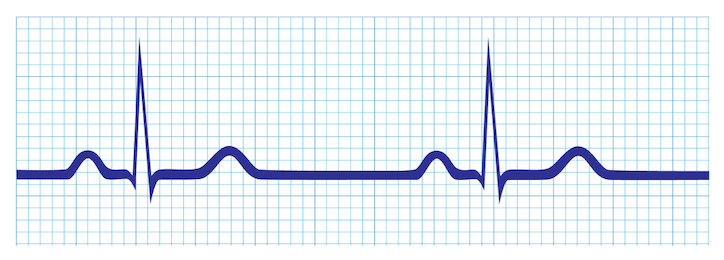
ECG-style illustration of a normal, regular heart rhythm
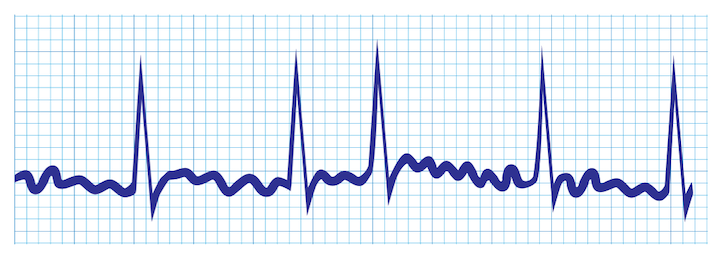
ECG-style illustration of an irregular heart rhythm
These simplified ECG-style illustrations are for general education only. They are not diagnostic ECG examples. Atrial fibrillation can only be confirmed through proper ECG-based assessment and medical interpretation.
Some people clearly feel an irregular heartbeat in their chest, throat, or neck. Others barely notice it at all. In that sense, it can sometimes be another silent issue — not because nothing is happening, but because the change in rhythm may be easy to miss.
Some people only become aware of it when they check their pulse, use a home blood pressure monitor, or are told about it during a routine appointment.
Why an irregular heartbeat can mean different things
Many people notice an odd beat, flutter, or brief uneven rhythm at some point in life. That is one reason this topic can be confusing. Some rhythm changes turn out to be short-lived. Others need proper medical assessment. The difficulty is that you usually cannot tell which is which from sensation alone.
That is why context matters. In other words, is the rhythm change new? Does it keep happening? Does it settle quickly? Does anything else come with it?
Stress, poor sleep, illness, dehydration, alcohol, caffeine, and some medicines can all affect how the heartbeat feels. But these do not automatically explain an irregular rhythm away. A new, repeated, or unexplained irregular heartbeat is worth taking seriously, even if it feels mild.
The safest message on this page is simple: common does not mean ignore it.
How to check for an irregular pulse
On our page How the heart works we explain that each heartbeat creates a pulse you can often feel at the wrist. On this page, the important question is not just whether you can feel the pulse, but whether it feels steady or uneven.
Checking your pulse cannot tell you exactly what rhythm you have, and it cannot diagnose the cause. But it can sometimes help you notice whether the beat feels regular or irregular.

Once you can feel the pulse, focus on the pattern rather than the number. Does it feel steady and even, like a clock ticking? Or does it seem to pause, hurry, flutter, or arrive unevenly?
A regular pulse often feels like this: beat ... beat ... beat ... beat
An irregular pulse may feel more like this: beat ... beat-beat ... (pause) ... beat ... beat
You are not trying to be perfect here. You are simply asking, “Does this feel evenly timed, or does it feel uneven?”
Checking your pulse is best thought of as a simple awareness tool. It may help you notice that something feels different, but it does not replace proper medical assessment if the rhythm is new, keeps returning, or comes with other symptoms.
Can a home blood pressure monitor detect an irregular heartbeat?
Many modern home blood pressure monitors do more than show a blood pressure reading. Some can also notice that the pulse pattern during the measurement did not seem completely regular.
This can be useful because some people do not clearly feel an irregular heartbeat themselves. They may only become aware of it when a monitor shows an irregular heartbeat symbol or a possible atrial fibrillation (AF/AFib) message.

A home blood pressure monitor may sometimes pick up an irregular pulse pattern during a reading.
That does not mean the monitor is diagnosing a heart rhythm condition. It simply means the device has noticed that the pulse waves during that reading did not arrive in a steady pattern.
This is where two features can sound similar but mean different things:
a general irregular heartbeat symbol means the pulse seemed uneven during the reading
a possible AF/AFib alert is a more specific screening feature designed to look for a pattern that may suggest atrial fibrillation
Both can be useful, but neither confirms a diagnosis.
If you want to understand one important cause of an irregular heartbeat in more detail, read our guide to atrial fibrillation (AF/AFib).
That is an important point for readers using home monitors. A general irregular heartbeat symbol does not mean you have atrial fibrillation. And a possible AF/AFib alert should be taken seriously, but it still does not confirm the diagnosis. A proper diagnosis usually requires an ECG (electrocardiogram), because that records the heart’s electrical activity directly.
This links closely to our Blood Pressure Monitor Guide, where we explain how home monitoring works in practice and why some monitors include rhythm-related features alongside blood pressure measurement
Is an irregular heartbeat the same as atrial fibrillation?
An irregular heartbeat is a broad description. It simply means the heartbeat is not following its usual steady pattern.
Atrial fibrillation (AF/AFib) is one specific type of irregular heart rhythm. In atrial fibrillation, the electrical activity in the upper chambers of the heart becomes disorganised, so the heartbeat can become irregular and is often faster than normal.
So the relationship is simple:
irregular heartbeat = a general description
atrial fibrillation = one possible cause of an irregular rhythm
That matters because not every irregular heartbeat is atrial fibrillation. Some people notice extra beats, brief flutters, or short-lived rhythm changes that are not AF/AFib. But atrial fibrillation is important because it is common, can sometimes cause few symptoms, and needs proper assessment rather than guesswork.
A pulse check, a monitor alert, or a routine appointment may be the first clue that something is not quite right. But none of these confirms the diagnosis.
Because atrial fibrillation is a specific condition with its own diagnosis, risks, and treatment, it is worth understanding separately and properly. You can read more in our full guide to atrial fibrillation.
Key takeaways: irregular heartbeat explained
An irregular heartbeat means the timing of the beats feels uneven, not simply fast or slow.
A new, repeated, or unexplained irregular heartbeat should not be ignored, even if it feels mild.
Feeling your pulse or noticing an alert on a home blood pressure monitor can help you spot a change in rhythm, but neither can diagnose the cause.
A general irregular heartbeat alert is not the same as a possible AF/AFib alert, and neither confirms a diagnosis.
If an irregular heartbeat keeps returning, does not quickly settle, or comes with symptoms such as dizziness, breathlessness, chest pain, or fainting, it needs proper medical attention.
When to seek medical help
This content is for general education only and does not diagnose heart rhythm problems or provide medical advice.
If you notice a new, repeated, or unexplained irregular heartbeat, or if a home blood pressure monitor repeatedly shows an irregular heartbeat or possible AF/AFib alert, speak with your doctor or another qualified healthcare professional.
If an irregular heartbeat comes with symptoms such as dizziness, breathlessness, chest pain, fainting, or if you feel suddenly very unwell, seek urgent medical help.
This page can help you understand what an irregular heartbeat may mean, but it cannot tell you which rhythm is present. That needs proper medical assessment.
If you want to understand more about home monitoring, our Blood Pressure Monitors Guide explains what to look for in a device and what monitor alerts can and cannot tell you.
If you would like to explore one important cause of an irregular heartbeat in more detail, read our guide to atrial fibrillation (AF/AFib).
Important Information:
This page is provided for general educational purposes only and does not constitute medical advice. Medical knowledge and guidance evolve over time, and information may change. Always seek advice from a qualified healthcare professional regarding personal health concerns or medical decisions.
For more details, please see our full Disclaimer.
Content last reviewed: May 2026
Next scheduled review: November 2026
We also review content sooner when important evidence, clinical guidance or safety information changes.