
How to Measure Blood Pressure at Home
A step-by-step guide to taking consistent and useful blood pressure readings at home.
Written by Ian Murray, Cardiac Physiologist
Blood pressure naturally changes throughout the day. Exercise, caffeine, smoking, stress, talking, and even how you sit can temporarily affect a reading.
That means how you measure your blood pressure matters.
The aim is not to make every reading identical or to find one “true” number. It is to estimate your usual blood pressure at rest under consistent conditions. Good technique reduces avoidable influences so that readings taken at different times can be compared more meaningfully. [1–4]
A single home blood pressure reading cannot diagnose high blood pressure. If your readings are repeatedly higher than expected, or you are concerned about them, speak with your doctor or another qualified healthcare professional.
New to blood pressure? If you want to understand what the numbers mean, why blood pressure can become high and why knowing your numbers matters, see our guide to High Blood Pressure.
Quick overview
Use the links below to jump to the section you need:
Why correct technique matters
Blood pressure continually changes as your body responds to activity, rest, emotions, meals, sleep and other influences. Some variation between readings is therefore normal.
Measurement technique can create additional differences. Taking a reading immediately after walking upstairs, talking during the measurement, sitting without back support or allowing your arm to hang below heart level can all affect the result.
Good technique cannot remove normal biological variation. Its purpose is to remove as many avoidable influences as possible. [1–4]
Before you begin: use a monitor you can trust
For routine home monitoring, use a clinically validated automatic blood pressure monitor, preferably one that measures around the upper arm. [1–4]
Clinical validation means that the particular monitor model has undergone recognised testing to assess how accurately it measures blood pressure.
The cuff must also fit your arm correctly. A cuff that is too small or too large can affect the measurement.
If you need help choosing a suitable device, our Blood Pressure Monitors Guide explains clinical validation, cuff size, upper-arm and wrist monitors, and the features available on modern devices.
Always follow your monitor's manufacturer instructions, along with the general measurement principles below.
If you have an irregular heartbeat or atrial fibrillation
An irregular rhythm can make it harder for some automatic monitors to measure blood pressure accurately. An irregular-heartbeat or AFib alert does not diagnose a rhythm condition or confirm that the blood-pressure reading itself is accurate.
If you have known atrial fibrillation, repeatedly see rhythm alerts or frequently have an irregular pulse, ask a healthcare professional whether your monitor and measurement method are suitable for you. [1,5]
For more information, see our guides to Irregular Heartbeat and Atrial Fibrillation.
How to take a blood pressure reading at home
Before starting, remember these four checks:

Step 1: Prepare before measuring
Try to measure under similar conditions each time.
For at least 30 minutes beforehand, avoid smoking, caffeine and exercise. [1–4]
If possible, also avoid measuring immediately after a large meal or drinking alcohol, and empty your bladder if needed.
Sit somewhere quiet and comfortable and rest for 5 minutes before starting. Avoid phone calls, messages or moving around during this rest. [1–4]
What time should you measure?
If you are collecting a planned series of home readings, try to measure around the same time each morning and evening.
Consistency is more important than choosing an exact minute.
If a healthcare professional has asked you to measure at a particular time, including in relation to medication, follow their instructions.
Do not delay, skip or change prescribed medication simply to obtain a blood pressure reading.

Step 2: Sit correctly
Sit on a chair with your back supported and both feet flat on the floor.
Keep your legs uncrossed. [1–4]
Remain in this position during your measurements.
Avoid sitting on the edge of a chair or on a stool without back support.
What if you feel dizzy when you stand?
Routine home blood pressure readings are usually taken sitting down. If you regularly feel dizzy or faint when you stand, or have had unexplained falls, tell a healthcare professional.
They may want to compare your blood pressure while lying or sitting with measurements taken after you stand. This can help identify postural hypotension — a drop in blood pressure when standing. Checking for this may be particularly relevant for older people, people with diabetes, and people taking blood-pressure-lowering medication. [1–3]
Step 3: Position your arm and cuff
Place the cuff around your bare upper arm, not over clothing.
Use the correct cuff size and follow the positioning markings supplied with your monitor. The cuff should be secure but not painfully tight.
Support your arm on a table, desk or cushion so that it is relaxed and the cuff is approximately level with your heart. [1–4]
Do not hold your arm up using your own muscles. Supporting it helps keep your arm relaxed throughout the measurement.
Which arm should you use?
If a healthcare professional has told you which arm to use, use that arm consistently.
Healthcare professionals normally check blood pressure in both arms during an initial assessment. If a persistent difference is confirmed, future measurements are generally taken from the arm with the higher pressure. [1–4]
If no one has specified an arm for you, use the same arm consistently for your home readings, and ask a healthcare professional to check both arms when appropriate.
Step 4: Take the reading
Start the monitor.
While it is measuring, stay still and quiet. Do not talk or use your phone. [1–4]
Allow the monitor to complete the measurement.
Then wait 1–2 minutes and take a second reading.
Record both readings.
If the monitor displays an error message, you move significantly during the measurement or the reading is interrupted, follow the manufacturer's instructions and repeat that measurement.
Avoid repeatedly checking your blood pressure until you obtain a number you prefer. The aim is to measure under consistent conditions, not to produce a particular result.
Record your results
Write down each result as displayed. A blood pressure reading is shown as:
Systolic / Diastolic
For example: 132 / 82 mmHg
If your monitor also displays your pulse rate, you can record that too.
Do not round the blood pressure numbers up or down.
If something unusual happened that might have affected a reading, such as illness, unusual stress, significant movement or a warning symbol on the monitor, add a short note.
A complete record helps you and your healthcare professional see patterns across several measurements rather than focusing on one number.
How to collect a useful short series of readings
One well-taken measurement gives you a snapshot. A planned series gives you more information because blood pressure varies from one measurement to the next and from day to day.
Before starting a planned series: Do not wait to complete seven days of readings if you develop emergency symptoms or obtain a very high reading. See When to seek medical help.
If you have been asked to collect home readings, a simple approach is to:
measure for 7 consecutive days;
have one measurement session in the morning and one in the evening;
take 2 readings each session, 1–2 minutes apart; and
record every reading. [1–4]
This gives up to four readings each day.
Try to use the same arm, similar measurement times and the same technique throughout the seven days.
Keep every reading in your record. Do not delete a result simply because it is higher or lower than the others.
Different clinical guidance uses slightly different methods for calculating a home blood pressure average. If a healthcare professional has asked you to calculate an average or follow a particular method, use the approach they recommend.
The most important part is collecting the readings consistently and keeping a complete record.
Download our free Home Blood Pressure Checklist & 7-Day Log
Follow a clear step-by-step checklist, then record seven days of morning and evening readings. Print the log and complete it by hand, or type directly into the fillable PDF and save a completed copy on your device.
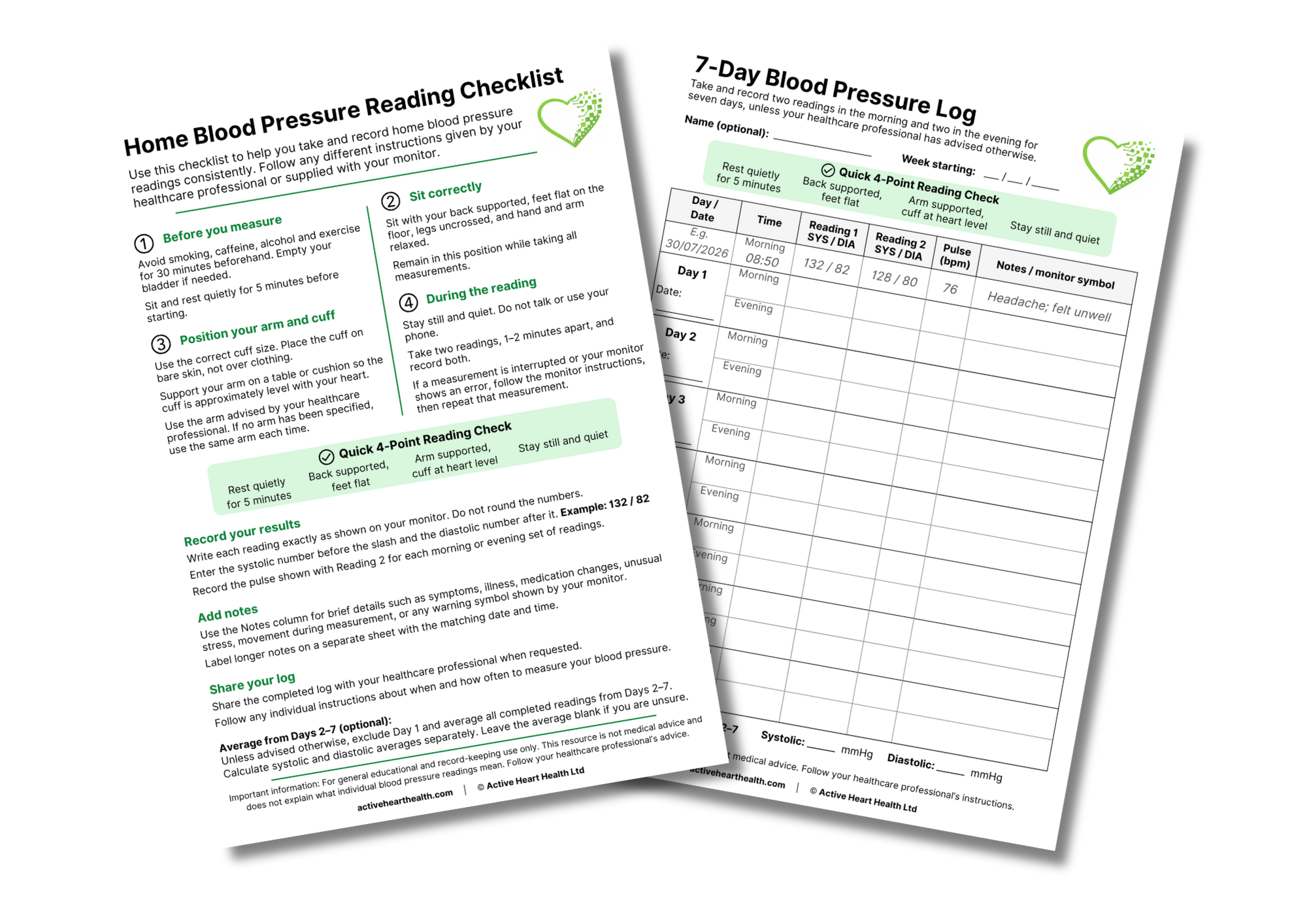
Free 2-page printable + fillable PDF
Collected your readings?
Once you have a series of home measurements, our Understanding Your Home Blood Pressure Readings guide explains how to look at the pattern, what a home blood pressure average means, and when to share your results with a healthcare professional.
Longer-term home monitoring
Home monitoring can also be useful after high blood pressure has been diagnosed, but more measurements are not automatically better.
How often you need to measure depends on your circumstances, treatment and the monitoring plan agreed with your healthcare professional. You may sometimes be asked to collect another short series before an appointment or after a change in treatment. [1–4]
Do not assume that a diagnosis of high blood pressure means you need to measure every day.
Do not start, stop or change prescribed blood-pressure medication because of individual home readings unless a healthcare professional has specifically told you how to respond.
Home readings are one part of blood pressure assessment. A healthcare professional may sometimes recommend measurements in a healthcare setting or a portable monitor that records blood pressure over 24 hours.
Common questions
What are the most common measurement mistakes?
The problems most likely to make readings harder to compare include:
measuring soon after exercise or caffeine;
skipping the five-minute rest;
sitting without back support or with your legs crossed;
placing the cuff over clothing;
using the wrong cuff size;
leaving the arm unsupported or below heart level; and
talking or moving during the measurement. [1–4]
Another common mistake is retaking readings repeatedly because you do not like the result.
Consistency matters more than trying to produce a particular number.
For a practical refresher, see 5 common mistakes when taking a home blood pressure reading.
What if the two readings are different?
Some difference between the first and second readings is normal.
Blood pressure naturally varies, and you have also been sitting quietly for slightly longer by the time you take the second reading.
Record both rather than keeping only the lower result.
If a measurement was clearly affected by significant movement or an error message, follow the monitor's instructions and repeat that measurement.
If your readings repeatedly differ much more than you expect despite using good technique, discuss them with a healthcare professional.
Ask a healthcare professional to check your technique
If you are new to home monitoring, unsure about your technique, or repeatedly getting unexpected results, consider taking your monitor with you to a healthcare appointment.
A doctor, nurse, pharmacist or another appropriately qualified healthcare professional may be able to check your cuff fit, posture, arm position and measurement technique.
If you have been given different instructions because of your individual circumstances, follow that professional advice.
Key Takeaways
Use a clinically validated monitor with the correct cuff size.
Good technique matters: prepare consistently, sit correctly, support your arm and remain still and quiet.
Take 2 readings approximately 1–2 minutes apart and record both.
For a structured 7-day series, have one measurement session in the morning and one in the evening, at similar times each day.
Focus on the pattern across repeated readings, and follow any longer-term monitoring plan agreed with your healthcare professional.
Do not wait to complete a planned series if you develop emergency symptoms or obtain a very high reading. Follow the safety advice below.
When to seek medical help
If your blood pressure is repeatedly much lower than usual and you feel dizzy, faint or unwell, contact a healthcare professional for advice.
Emergency symptoms
Seek emergency medical help immediately if you think you may be having a heart attack or stroke, have severe difficulty breathing, lose consciousness or have another life-threatening emergency. [1,2,6,7]
Possible warning signs include new chest pain, sudden weakness or numbness on one side of the body, facial weakness, difficulty speaking or sudden severe breathing difficulty.
Do not wait for a particular blood pressure number and do not delay seeking emergency help while repeatedly checking your blood pressure.
A very high reading when you otherwise feel well
A systolic reading of 180 mmHg or higher, or a diastolic reading of 110 mmHg or higher, is very high. [2,3]
If you get a reading at or above either level and otherwise feel well, sit quietly for several minutes and repeat the measurement using the correct technique.
If the repeated reading is still at or above either level, seek urgent medical advice.
A single home reading at this level does not by itself diagnose severe hypertension, but it should not be ignored.
Do not take additional blood pressure medication unless a healthcare professional has specifically advised you to.
What next?
Already collected your readings?
Learn how home blood pressure readings are generally assessed, what 135/85 mmHg means, and when professional advice may be appropriate.
Need a home monitor?
Our Blood Pressure Monitors Guide explains clinical validation, cuff size and the features worth considering before you buy.
Important Information
This page is provided for general educational purposes only and does not constitute medical advice. Medical knowledge and guidance evolve over time, and information may change. Do not use home blood pressure readings to diagnose a medical condition or to start, stop, or change medication without appropriate professional advice. Always seek advice from a qualified healthcare professional regarding personal health concerns or medical decisions.
For more details, please see our full Disclaimer.
References
National Institute for Health and Care Excellence. Hypertension in adults: diagnosis and management (NG136). Last updated 26 February 2026.
McEvoy, J.W., McCarthy, C.P., Bruno, R.M., et al. 2024 ESC Guidelines for the management of elevated blood pressure and hypertension. European Heart Journal. 2024;45(38):3912–4018.
Mancia, G., Kreutz, R., Brunström, M., et al. 2023 ESH Guidelines for the management of arterial hypertension. Journal of Hypertension. 2023;41(12):1874–2071.
Parati, G., Stergiou, G.S., Bilo, G., et al. Home blood pressure monitoring: methodology, clinical relevance and practical application. Journal of Hypertension. 2021;39(9):1742–1767.
National Institute for Health and Care Excellence. Atrial fibrillation: diagnosis and management (NG196). Last updated 30 June 2021.
NHS. Heart attack. NHS health information.
NHS. Symptoms of a stroke. NHS health information.
Content last reviewed: September 2026
Next scheduled review: March 2027
We also review content sooner when important evidence, clinical guidance or safety information changes.